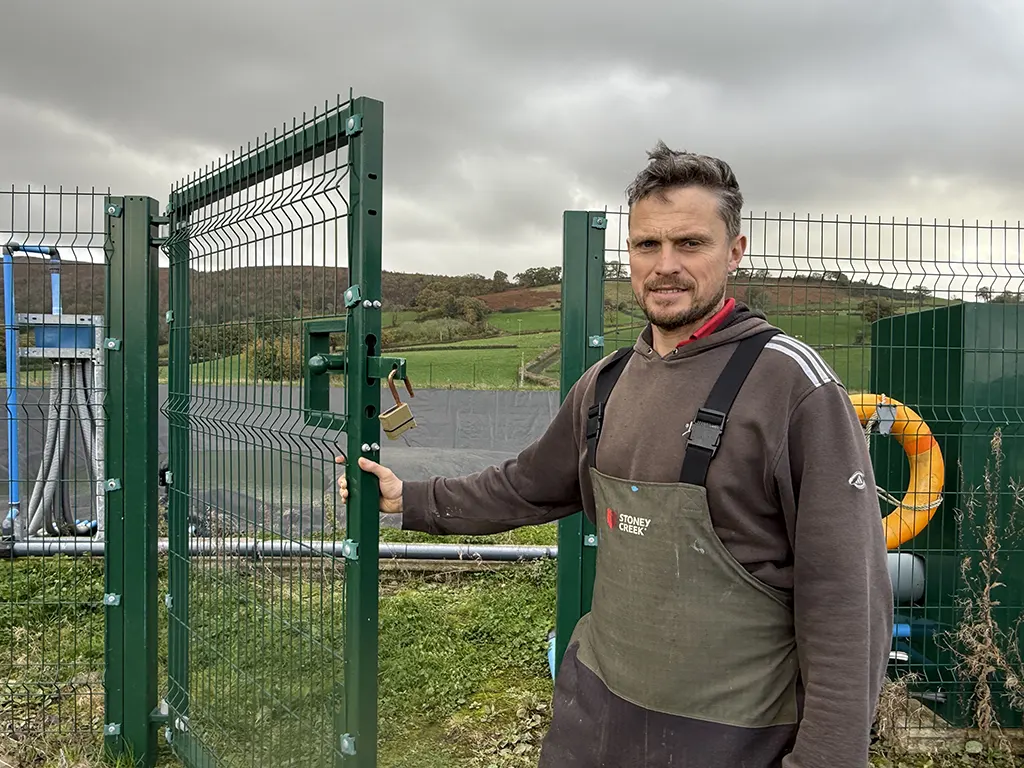
Investing in a two million gallon (9,000m3) aerated slurry lagoon with eight months storage and a floating cover has future proofed the unit, says Rheinallt Harries who together with his wife, Rachel manages a 240-cow spring block calving herd unit near Bethlehem, Carmarthenshire.
“The investment is paying hands down”, he says. “Aerating the slurry has enhanced the slurry’s nutrient value to the extent we’ve been able to cut our nitrogen fertilizer requirements by 30%, and its ready to spread when we choose to, without any agitation or the need to add water as it’s already mixed. Running costs are minimal, we are saving on labour, machinery and diesel and we expect return on investment within eight years.
“We agreed this method was the way to go, simply because as tenant farmers we’re focused on minimizing both fixed and variable costs – our objective is to turn grass in to milk in a low input low output grazing system,” he explains.
“Since taking on the farm’s tenancy almost 10 years ago, we had refurbished the parlour, silage clamp and water system and installed cow tracks. Increasing the capacity of the 250,000-gallon tin tank which had just three weeks storage, was last on the to do list. At the time there was no closed period; every three weeks during the winter housing period we were throwing slurry over hedges and wasting nutrients. It was also costing up to £70 to agitate and mix to get it out of the tank each time.
“A lagoon worked out to be the most cost-effective to increase storage capacity to two million gallons, the scale we needed for this size of unit without the stress of having to get slurry out or spreading it at inappropriate times. Excavating a hole and lining it cost 10 times less than investing in another tin tank or building a concrete tank with slats and a roof,” he says.
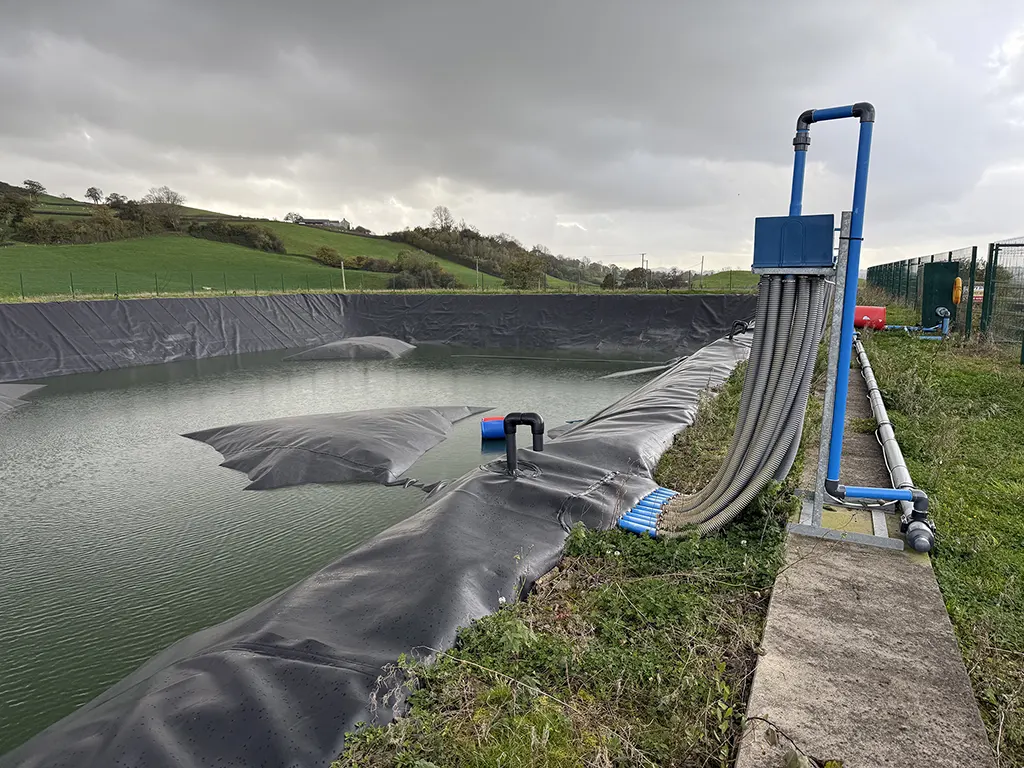
“We also decided to introduce the floating cover otherwise with an annual 70” rainfall, we would have ended up with an extra 750,000 gallons of slurry a year costing up to £10,000 to cart out and spread, when in fact it’s now capturing that rainwater separately. We then UV filter that water and use it to wash down the parlour so making further cost savings as that’s up to 2,500 gallons a day.
“When it came to how we were going to mix slurry in a lined and covered lagoon, I didn’t like mechanical agitators due to their associated problems including ripping the lining. That’s when we began to explore aeration and found that Dairypower’s fully automated Smart Slurry aeration system, along with its other benefits, was the only one with the pipes safely secured to the lagoon floor.”
Work commenced in autumn 2022 and was completed four months later. To meet with safety requirements the lagoon was closed off with a two metre high security fence.
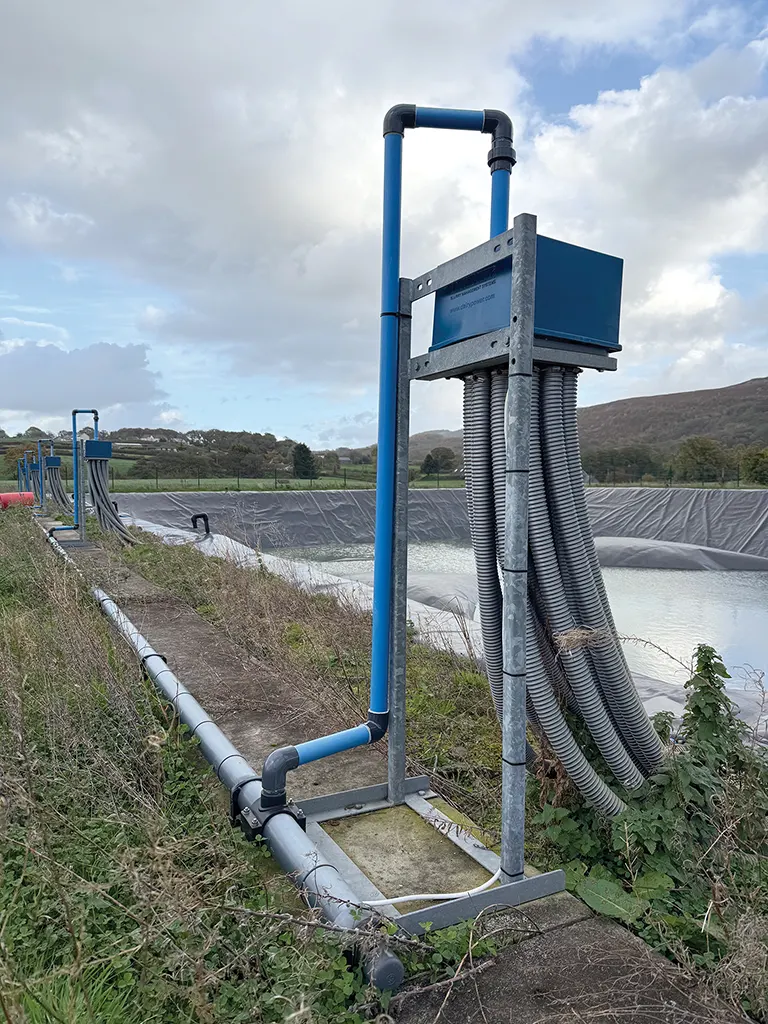
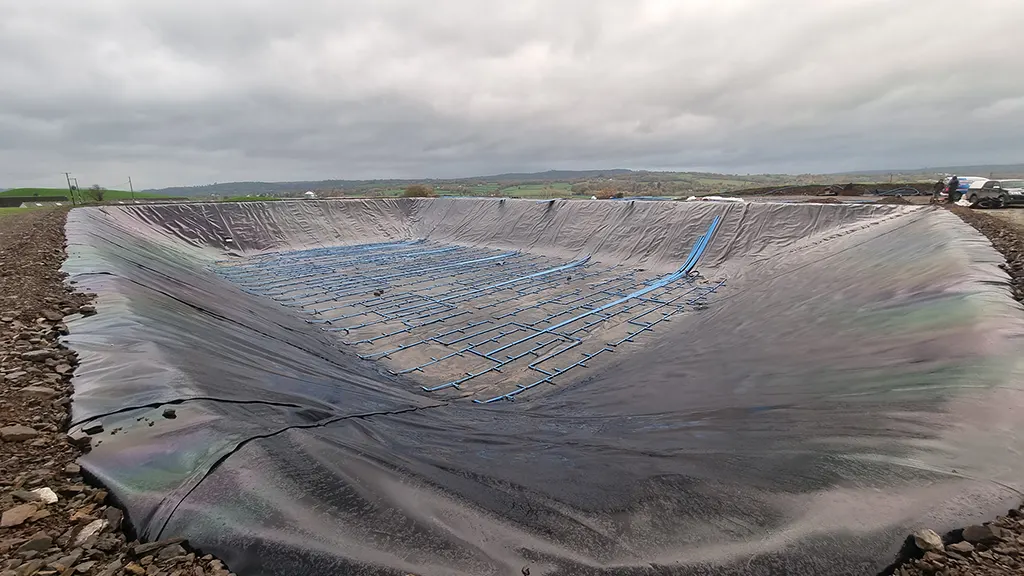
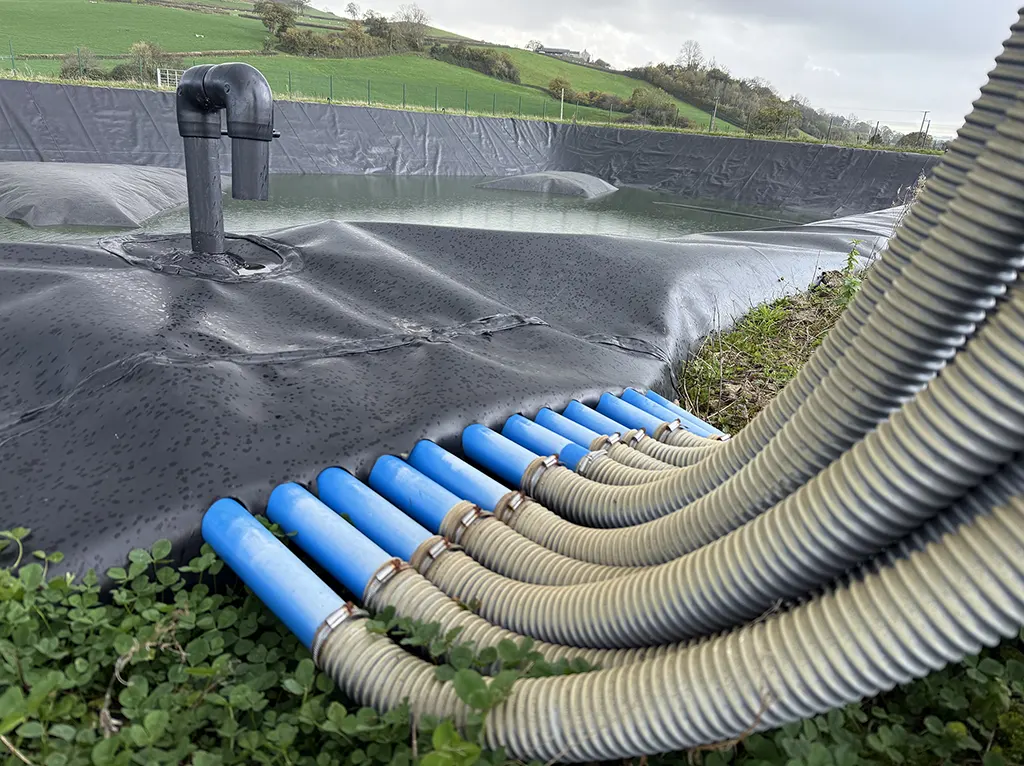
The custom designed aeration system features over one mile of non-degrading uPVC pipework covering the 52m x 35m base of the lagoon. The 50mm diameter pipes are connected to the layout of aeration manifolds which have multiple self-closing non-return outlets.
Rheinallt’s Smart Slurry aeration system is serviced by a single pump unit and five patented rotary values which distribute a high-volume of low-pressure air to each manifold.
The aeration system is programmed to run automatically six times a day pumping air on a rotary basis around the whole lagoon. The rising air bubbles automatically mix the slurry into a consistent homogeneous and pumpable state 365. It runs on 5.5kWh generated by the Harries own solar generated power otherwise they estimate it would cost £6.30 per day off-peak. Maintenance requirements are minimal – their system is serviced twice a year.
Slurry and yard washings are initially pumped into the Harries’ existing tin tank positioned near the parlour, before being pumped as and when needed 180 metres to the lagoon located off site from the main steading. Slurry is pumped out of the lagoon via a sump to one of two main outlet pipes which connect up to an umbilical spreading system. The Harries’ contractor begins spreading on to the silage leys from March onwards, following each of the three to four cuts, while two applications are made to the grazing platform during the year, depending on weather conditions.
Rheinallt adds: “Apart from the cost efficiency aspect, investing in the Smart Slurry aeration system is proving to be safer for the environment as well as ourselves. We’ve noticed reduced odour while spreading while the slurry’s improved nutrient content is enabling us to take more forage from our own resources.”
This article was featured in Dairy Farmer, December 2025. Read it here